Boring postcards of the future?
During the break last class, I was reminded of James Howard Kunstler's feature, Eyesore of the Month. Kunstler is an American social critic/author who wrote the book The Geography of Nowhere, a history of urban sprawl and suburbia in the US. These days, his main concern is the impending (or is it current?) oil crisis. He's a key figure of the New Urbanist movement (which, as perceptive and thoughtful Vancouverites, we all owe it to ourselves to learn about) and is deeply ambivalent about all those Bad Things like SUVs and highways and Wal-Mart. Kunstler's blog, Clusterfuck Nation, is here, and is generally an engagingly belligerent read.
You might have already guessed why my brain linked Kunstler's name to Parr's Boring Postcards collection - the utopian, motorway-centric Modernist urban planning Parr documents is precisely what Kunstler finds the most apalling about Western culture. Some of Kunstler's Eyesores look eerily similar to the images in Parr's books...but the images aren't the only thing of interest here - Kunstler's sarcastic write ups are also top notch:

Nelson Rockefeller, the Captain Kirk of Modern Art patrons, arranged for this UFO to land like a Vulcan acropolis in in the Center of New York state's capital city around 1972. One unfortunate byproduct of the Empire State Plaza and its accessory freeway ramps: they obliterated the south end of the city. Note the granite fortification wall where the freeway terminates, and the forbidding maw of darkness that the motorist is compelled to enter in order to gain access to the internal workings of this bureaucratic mega-machine. Governor Rockefeller regarded it as a kind of ultra-pop sculpture garden, best viewed from freeway ramps. What happened on the ground didn't matter.

What was going through their minds in the sixties?
Remember, buildings like this department store in Meridian, Mississippi, were designed and built by people who were AGAINST hallucinogenic drugs. Note how the colorful banners on the pole in front really "dress it up."
Kunstler offers us a contemporary interpretation of the mid-century developments cataloged by Parr. Looking at these dreary roadways and concrete-block buildings, even uglier now than when they were built (years of grime and wear aren't kind to concrete - sorry, SFU), it's even harder to comprehend the unbridled enthusiasm displayed for such things in Parr's books and old news clips like the one Susan showed us last class.
Kunstler's criticism does not end in the Modern era, however - some of his Eyesores are shiny, new, critically-acclaimed buildings - buildings which might easily end up on the postcards and brochures of today. I find these particularly interesting:
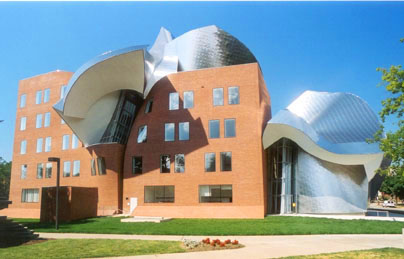
The Peter B. Lewis Building for Case Western Reserve University's Weatherhead School of Management. Architect: Frank Gehry. If your dog had a tumor like this the vets would just shake their heads and put him to sleep. The design follows the logic of cancer: invade and overwhelm the host organism. It's appropriate that this building houses the business school, because it aptly expresses the disfigurement of American economic practice in our time: banality meets pathology in a tragic duet.

Behold the model for Frank Gehry's Museum of Tolerance now under construction in Jeruselum. Financed by Americans, the museum makes an interesting case in its sheer physical form: the Post-modern must not just be tolerated, it has to be suffered. The citizens of Jeruselum will now have to suffer a building that looks like a pile of floor sweepings from a machine shop.
(He's really not fond of Gehry.)

Behold the new $30 million Ontario College of Art & Design classroom and studio building by British architect Will Alsop -- a totemized retro-futuroid coffee table joined umbilically to its Soviet-style predecessor below. The message, apparently: art and design are nothing but fun fun fun. Nothing to get serious about. A playful spirit of induced hazard will keep students wondering when the checkered box might wobble free of its cute swizzle-stick legs and come crashing down on their heads. This exercise in hyper-entropic avant garde faggotry is so cutting edge that it is already out of date. The only question: which of the two conjoined buildings is more cruelly ridiculous?
Kunstler is onto something here. Still utterly fixated on the ever-new, it seems [some of] the architects of today haven't learned from their Modernist predecessors; they're continuing to build structures "so cutting edge [they are] already out of date." These extravagant, outlandish buildings are great monolithic expressions of our culture's boredom, imposing their message of newness - sweet, whimsical newness! - onto the streets and people around them. The terrible thing is, though, once these monuments to newness become boring or old, we cannot simply discard them and move onto something newer still; the buildings might lose their charm, but they retain their practical use, and we have to continue living and working in them, not to mention looking at them, for years and years to come. It's dismal. I wonder what people's reactions to these buildings will be in the future - will they be as bemusedly perplexed as ours to Parr's Boring Postcards? Honestly, though, what are they thinking? It's frightening to think that the current vision of the cutting-edge is so stubbornly fixated on the unique. If we think the dingy boxes of 60s architecture are out-of-place blots on our streetscapes, just imagine what these things will look like in a few years. Can you imagine the horror of having one of Gehry's melted, blobby buildings in our city? Sure they're fun, refreshing, and thought-provoking in their unique blobby way for the time being, but when this brand of architecture goes out of style - which I pray it will soon - they are going to pollute their cities with the absurdity of 1000 Space Needles. I wonder if buildings this aggressively absurd will ever be viewed as boring. Ugly or not, they're certain to generate emotional and opinionated reactions (like this one).
For a fun aside, here are my favourite unrelated Eyesores:
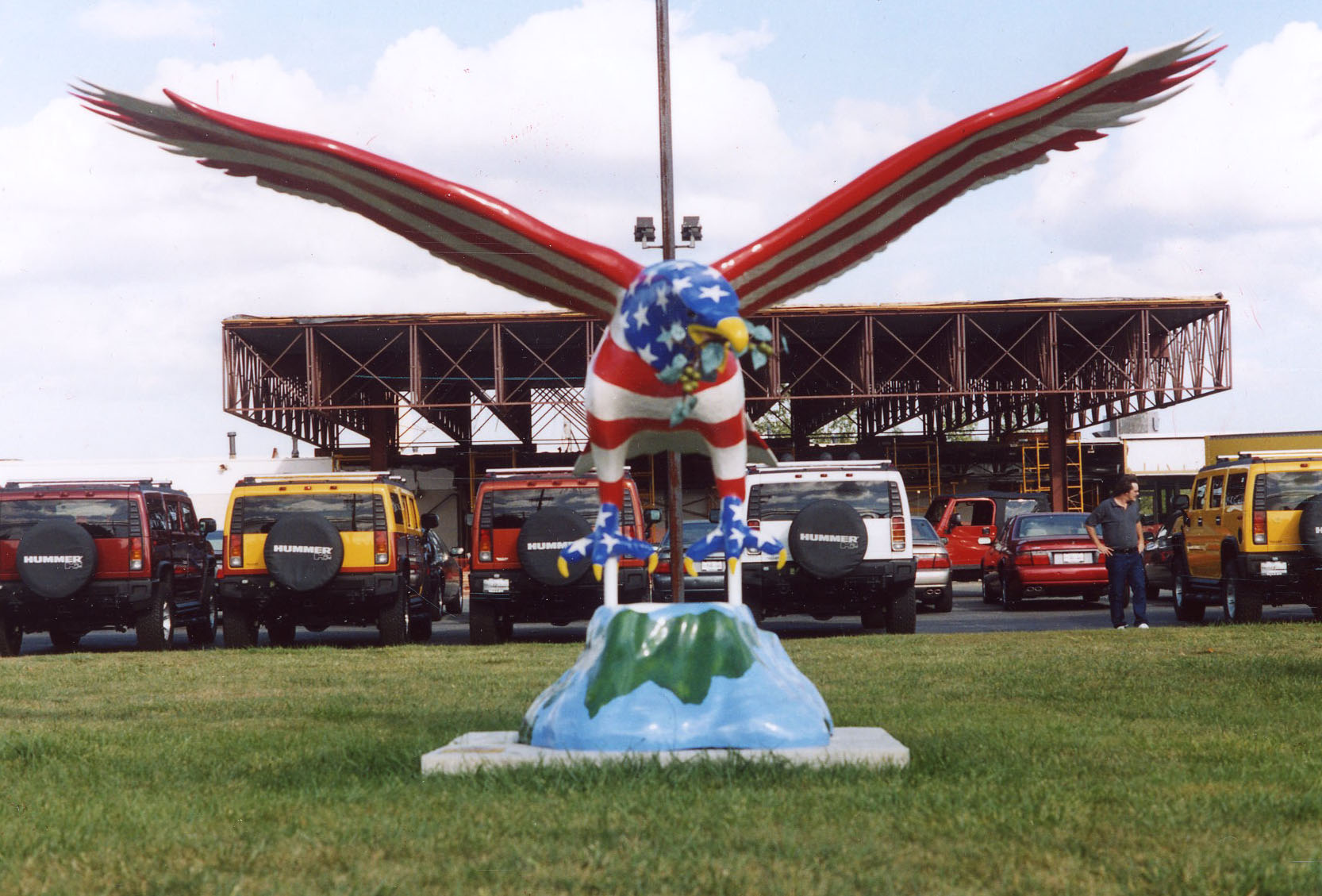
This one says it all -- and thanks to Judy Peer of Rochester, New York -- who found this monument to greed and chauvinism on Winton Road there. The tattooed eagle straddles a lumpish, deflated earth (perhaps punctured by its talons) before the ranks of Humvees waiting for buyers who can take advantage of the special corporate tax break for vehicles over 6000 pounds (nice work Karl Rove!). Notice, the setting is one of those innumerable places not worth caring about which someday will add up to a nation not worth defending.
This one is a series of pictures, so I can't easily duplicate it here. Certainly worth clicking on the link, though.
What do you guys think of Kunstler's critical look at the boring postcards of the past and future?
You might have already guessed why my brain linked Kunstler's name to Parr's Boring Postcards collection - the utopian, motorway-centric Modernist urban planning Parr documents is precisely what Kunstler finds the most apalling about Western culture. Some of Kunstler's Eyesores look eerily similar to the images in Parr's books...but the images aren't the only thing of interest here - Kunstler's sarcastic write ups are also top notch:
Nelson Rockefeller, the Captain Kirk of Modern Art patrons, arranged for this UFO to land like a Vulcan acropolis in in the Center of New York state's capital city around 1972. One unfortunate byproduct of the Empire State Plaza and its accessory freeway ramps: they obliterated the south end of the city. Note the granite fortification wall where the freeway terminates, and the forbidding maw of darkness that the motorist is compelled to enter in order to gain access to the internal workings of this bureaucratic mega-machine. Governor Rockefeller regarded it as a kind of ultra-pop sculpture garden, best viewed from freeway ramps. What happened on the ground didn't matter.
What was going through their minds in the sixties?
Remember, buildings like this department store in Meridian, Mississippi, were designed and built by people who were AGAINST hallucinogenic drugs. Note how the colorful banners on the pole in front really "dress it up."
Kunstler offers us a contemporary interpretation of the mid-century developments cataloged by Parr. Looking at these dreary roadways and concrete-block buildings, even uglier now than when they were built (years of grime and wear aren't kind to concrete - sorry, SFU), it's even harder to comprehend the unbridled enthusiasm displayed for such things in Parr's books and old news clips like the one Susan showed us last class.
Kunstler's criticism does not end in the Modern era, however - some of his Eyesores are shiny, new, critically-acclaimed buildings - buildings which might easily end up on the postcards and brochures of today. I find these particularly interesting:
The Peter B. Lewis Building for Case Western Reserve University's Weatherhead School of Management. Architect: Frank Gehry. If your dog had a tumor like this the vets would just shake their heads and put him to sleep. The design follows the logic of cancer: invade and overwhelm the host organism. It's appropriate that this building houses the business school, because it aptly expresses the disfigurement of American economic practice in our time: banality meets pathology in a tragic duet.
Behold the model for Frank Gehry's Museum of Tolerance now under construction in Jeruselum. Financed by Americans, the museum makes an interesting case in its sheer physical form: the Post-modern must not just be tolerated, it has to be suffered. The citizens of Jeruselum will now have to suffer a building that looks like a pile of floor sweepings from a machine shop.
(He's really not fond of Gehry.)
Behold the new $30 million Ontario College of Art & Design classroom and studio building by British architect Will Alsop -- a totemized retro-futuroid coffee table joined umbilically to its Soviet-style predecessor below. The message, apparently: art and design are nothing but fun fun fun. Nothing to get serious about. A playful spirit of induced hazard will keep students wondering when the checkered box might wobble free of its cute swizzle-stick legs and come crashing down on their heads. This exercise in hyper-entropic avant garde faggotry is so cutting edge that it is already out of date. The only question: which of the two conjoined buildings is more cruelly ridiculous?
Kunstler is onto something here. Still utterly fixated on the ever-new, it seems [some of] the architects of today haven't learned from their Modernist predecessors; they're continuing to build structures "so cutting edge [they are] already out of date." These extravagant, outlandish buildings are great monolithic expressions of our culture's boredom, imposing their message of newness - sweet, whimsical newness! - onto the streets and people around them. The terrible thing is, though, once these monuments to newness become boring or old, we cannot simply discard them and move onto something newer still; the buildings might lose their charm, but they retain their practical use, and we have to continue living and working in them, not to mention looking at them, for years and years to come. It's dismal. I wonder what people's reactions to these buildings will be in the future - will they be as bemusedly perplexed as ours to Parr's Boring Postcards? Honestly, though, what are they thinking? It's frightening to think that the current vision of the cutting-edge is so stubbornly fixated on the unique. If we think the dingy boxes of 60s architecture are out-of-place blots on our streetscapes, just imagine what these things will look like in a few years. Can you imagine the horror of having one of Gehry's melted, blobby buildings in our city? Sure they're fun, refreshing, and thought-provoking in their unique blobby way for the time being, but when this brand of architecture goes out of style - which I pray it will soon - they are going to pollute their cities with the absurdity of 1000 Space Needles. I wonder if buildings this aggressively absurd will ever be viewed as boring. Ugly or not, they're certain to generate emotional and opinionated reactions (like this one).
For a fun aside, here are my favourite unrelated Eyesores:
This one says it all -- and thanks to Judy Peer of Rochester, New York -- who found this monument to greed and chauvinism on Winton Road there. The tattooed eagle straddles a lumpish, deflated earth (perhaps punctured by its talons) before the ranks of Humvees waiting for buyers who can take advantage of the special corporate tax break for vehicles over 6000 pounds (nice work Karl Rove!). Notice, the setting is one of those innumerable places not worth caring about which someday will add up to a nation not worth defending.
This one is a series of pictures, so I can't easily duplicate it here. Certainly worth clicking on the link, though.
What do you guys think of Kunstler's critical look at the boring postcards of the past and future?
posted by Sarah at 11:14 PM


3 Comments:
I do think Kunstler is a bit too much of a curmudgeon to appreciate absurdity in architecture, and on that point, he might be wrong - the playful buildings of today may well be cherished along the road.
His main complaint, though, is how these buildings (I'm talking mostly about Gehry here) interact with pedestrians - structures like these might look interesting in a photograph or as seen from the road, but they are less-than-engaging from a sidewalk level. This is precisely how such buildings can appear boring - rather than contributing to a lively street atmosphere, they make their neighbourhoods gloomier and less inviting. Just look at this eyesore!
One correction: the department store in Meridian MS is actually the addition to the phone company (Bell South then, AT&T most recently, soon to be redeveloped in some way). Interesting conversation on the interaction of buildings, surroundings, & the people in the community.
One correction: the department store in Meridian MS is actually the addition to the phone company (Bell South then, AT&T most recently, soon to be redeveloped in some way). Interesting conversation on the interaction of buildings, surroundings, & the people in the community.
Post a Comment
<< Home